
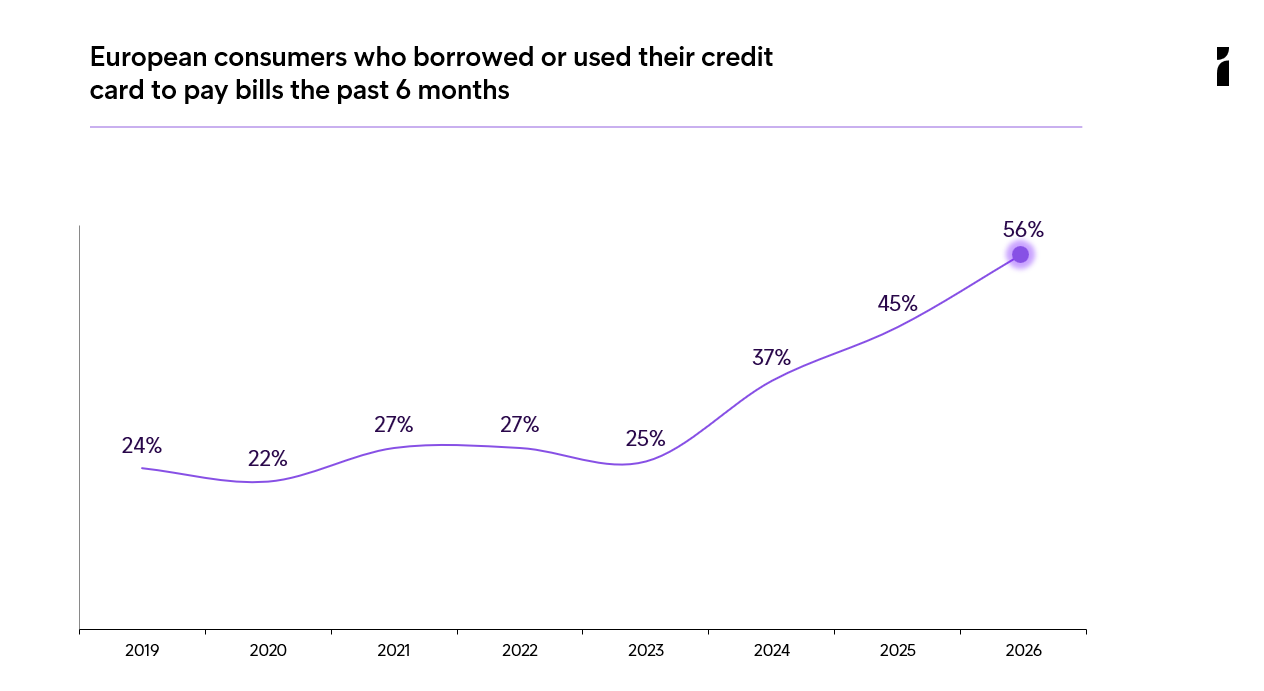
Consumers can meet their immediate needs, but signs of financial pressure are growing beneath the surface. 56% have borrowed money or used credit to pay bills in the past six months, up from 45% last year, while late payments have increased after two years of improvement. Financial pressure affects consumers in different ways. Some respond by becoming increasingly cautious about spending, while others turn to flexible payment options to cope.
Intrum’s annual European Consumer Payment Report, based on a survey of 20,000 consumers across 20 European countries, finds that 56% have borrowed money (excluding mortgages) or used a credit card to pay bills at least once during the past six months, up from 45% in 2025.
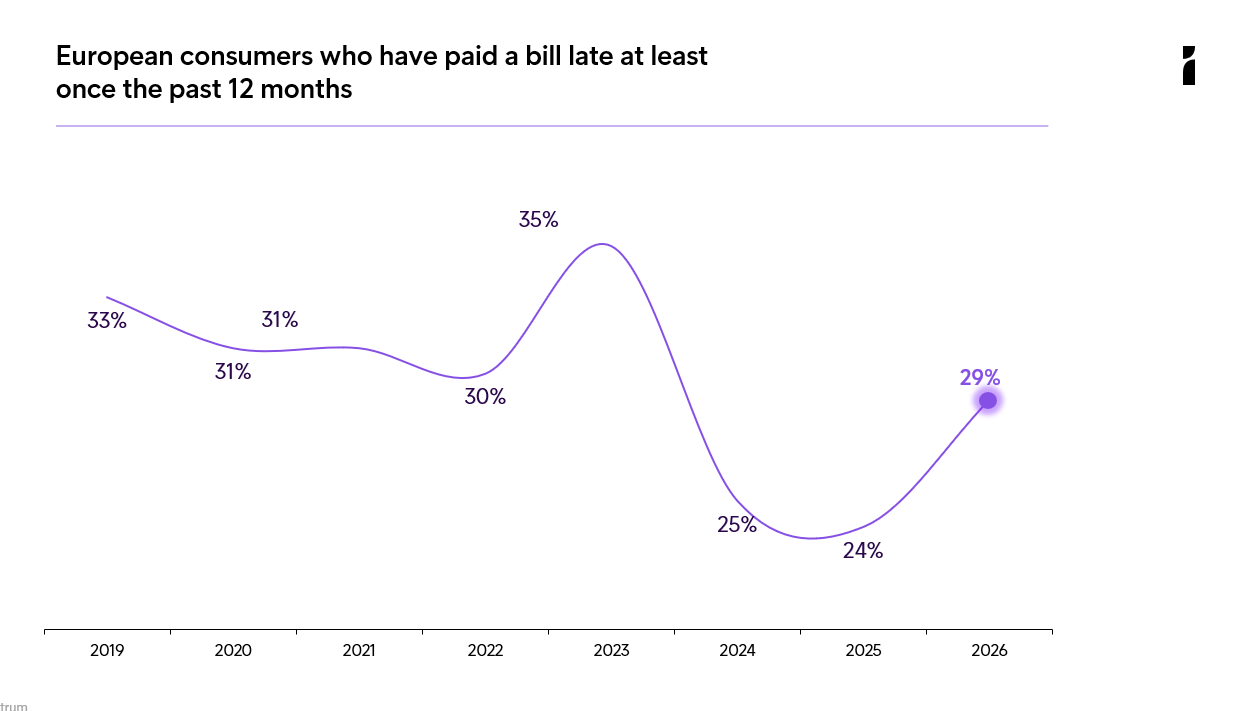
At the same time, 29% say they have paid at least one bill late during the past 12 months, up from 24% in 2025. The increase marks a change in direction after two consecutive years of improvement, when late payments fell from 35% in 2023 to 25% in 2024 and 24% in 2025.
Germany, Switzerland and France have the highest shares of consumers paying bills late, at 53%, 39% and 37%. Germany stands out, with the share rising sharply from 26% in 2025. The increase is mainly driven by more consumers paying 2–4 bills late, rather than persistent non-payment.
The findings point to growing financial pressure beneath otherwise relatively resilient household finances. Eight in ten consumers (80%) remain confident that they can afford everyday essentials, and 78% are confident they can pay all their bills each month. Occasional borrowing or late payments do not necessarily mean a household is in financial difficulty. But the increase in both suggests that more households may be facing growing financial pressure.
Johan Åkerblom, President and CEO of Intrum, comments:
“European consumers have shown considerable resilience through several years of economic uncertainty, but our research suggests that this is becoming more difficult to maintain. The increase in late payments and the growing use of credit to cover bills, alongside greater caution and increased savings, show how consumers are adapting to continued financial pressure. Financial health matters to the wider economy, as uncertainty affects how people spend, save and make longer-term financial decisions.”
Economic uncertainty makes consumers more cautious
Economic uncertainty is also making consumers more cautious about spending and taking financial risks. 58% say the economic environment has made them more nervous about making a major purchase, compared to 45% last year. Meanwhile, 57% say they are more wary of taking financial risks, up from 50%.
Consumers are responding by strengthening their financial buffers where possible. 66% now say they put money aside each month for unexpected expenses, up from 60% in 2025, while 49% say they are prioritising saving over spending, compared with 41% last year.
Taken together, the findings point to a more cautious financial mindset, as consumers prioritise saving while managing continued pressure on household finances.
BNPL serves very different purposes depending on consumers’ financial health
The changing financial environment is also reflected in how consumers choose to pay.
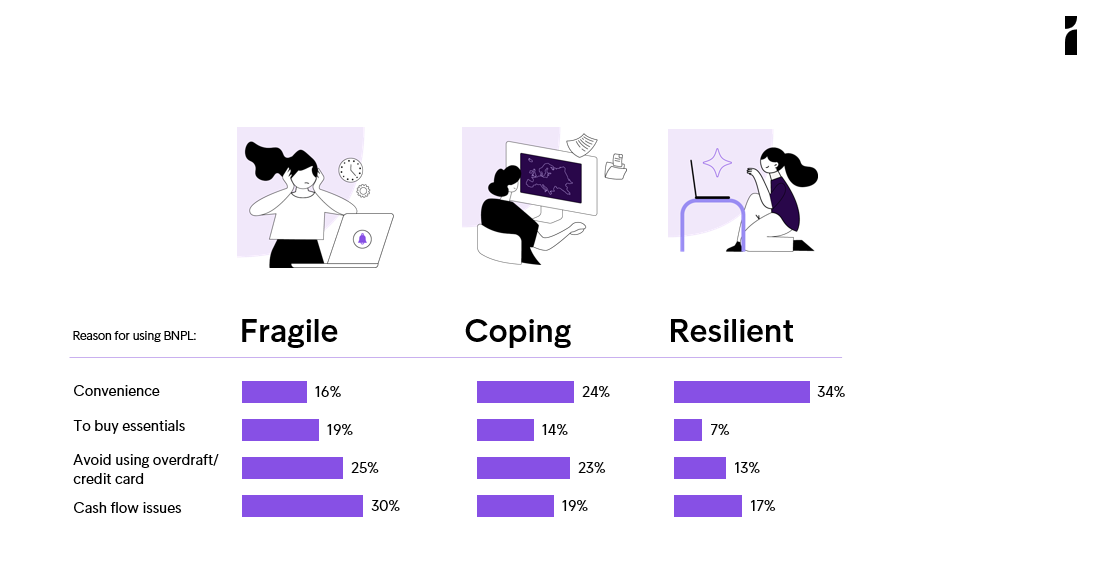
Four in ten European consumers have used buy now, pay later services during the past year. However, the role BNPL plays differs significantly depending on consumers' underlying financial health. Among financially resilient consumers, 34% say they use BNPL primarily for convenience, compared with 16% of fragile BNPL users. Fragile consumers are more likely to use it to manage cash flow, buy essentials or make purchases they could not otherwise afford.
AI becomes part of personal financial management
Consumers are also increasingly turning to technology to manage their finances. 29% now say they use AI tools to help manage their personal finances, more than double the 13% recorded in 2025.
44% of European consumers say they would be comfortable using an AI assistant to resolve a payment issue or set up a payment plan. At the same time, 56% say they would trust AI more if they knew they could speak to a human adviser when needed.
The findings suggest that digital tools are becoming a more established part of how consumers manage financial decisions, while human support remains important when circumstances become more complex.
Read more about the survey results here: intrum.com/ecpr2026