

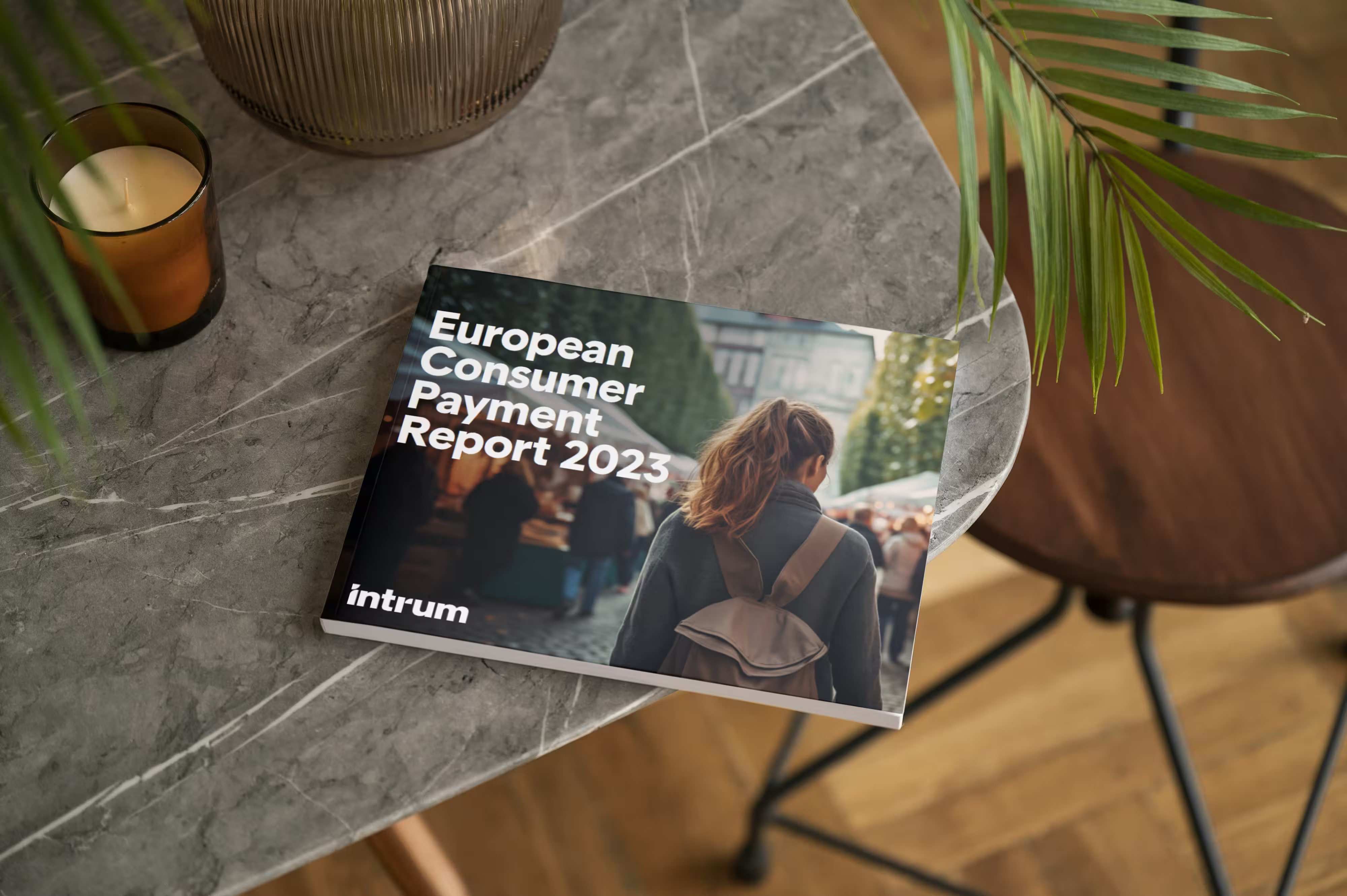
European Consumer Payment Report 2026
The European Consumer Payment Report 2026 is based on insights from 20,000 consumers across 20 European countries. It provides an overview of consumers' ability to pay bills on time and highlights evolving attitudes towards financial commitments. The insights was released in September 2026.
1. Consumers remain resilient
Many Europeans continue to manage their financial commitments despite prolonged economic uncertainty. But headline resilience hides significant differences between consumers and markets. Late payments and reliance on borrowing are increasing.
2. Financial vulnerability looks different across consumers
The ability to absorb unexpected costs and manage rising expenses varies considerably. Some consumers respond by becoming increasingly cautious about spending while others turn to flexible payment options or avoidance to cope.
3. Better engagement can prevent problems from escalating
Europeans are increasingly turning to technology to manage their finances and the use of AI for personal finances has doubled. AI and digital tools can lower barriers to support, particularly for financially fragile consumers, while human support remains important.

Europe’s consumers are coping – but pressure is building beneath the surface
Most European consumers can still meet their immediate financial commitments and their financial health show considerable resilience.
The vast majority (80 per cent) say they are confident in their ability to cover the cost of essentials like food and fuel, 70 per cent say they are comfortable that they can provide for their families, and 71 per cent can cover an unexpected cost of €400.

Confidence somewhat drops, however, when people look further ahead. Just over half are confident about saving enough for retirement, 47 per cent believe they can live without worrying about money and only 36 per cent feel financially able to switch careers to avoid redundancy.
This gap between managing today and feeling secure about tomorrow helps explain why uncertainty is having an influence on financial behaviour. The ECPR 2026 also show that consumers are protecting themselves where they can – but they are also becoming more cautious about major purchases, career moves and other financial risks.

Signals beneath the headline resilience
Caution about the future is not just a matter of perception: looking at late payment trends, we can see that financial pressure is increasing. After two years of improvement, late payments are on the rise again. But missed payments are just one indication of pressure. Consumers are also borrowing more to keep on top of their financial commitments.

Late payments are rising
Late payments are rising after two years of improvement, with significant variation across Europe. Nearly one in three consumers (29 per cent) say they have paid at least one bill late in the past 12 months.
The increase is primarily concentrated among consumers reporting two to four late payments, rather than those experiencing frequent non-payment.

Germany, Switzerland and France have the highest shares of consumers paying bills late, at 53 per cent, 39 per cent and 37 per cent.
Germany stands out, rising sharply from 26 per cent in 2025 – driven mainly by more consumers paying late occasionally, rather than persistent non-payment. It is too early to say whether this marks a lasting trend.

Increasing borrowing to keep bills paid
More than half (56 percent) say they have borrowed money or used a credit card in the past six months to pay a bill – the highest proportion since 2019. This adds complexity to the picture of consumer resilience.
Occasional borrowing or isolated late payments do not mean a household is in financial difficulty. But the rise in both suggests that headline confidence alone does not tell the full story of Europeans’ financial health.

Financial pressure does not produce one type of behaviour
The 2026 findings also challenge simple assumptions about how consumers respond when money becomes tighter.
More consumers are trying to protect themselves: 66 per cent are building an emergency fund and 49 per cent say they prioritise saving even when it means sacrificing things they enjoy.

At the same time, 45 per cent say they spend money to feel better when they are stressed, anxious or bored – up sharply from 29 per cent in 2025.
Consumers can therefore display financially protective and potentially harmful behaviours at the same time. Understanding financial health requires looking at the combination of behaviours and circumstances behind the numbers, rather than labelling people as simply ‘responsible’ or ‘irresponsible’.

For some consumers, financial pressure leads to avoidance
For some consumers, the emotional response to financial pressure takes a different form altogether: they disengage.
1 in 4 debt strugglers avoid dealing with debt because it makes them anxious.
The Money Management Index persona data shows this isn't evenly distributed. Concerningly, this behaviour (e.g. avoiding balance checks, communications and opening bills) is most common among those in the weakest financial health.

That can create a self-reinforcing cycle. Financial difficulty creates anxiety, anxiety discourages action, then delayed action allows the problem to become harder to resolve.
It also presents a difficult paradox: those most in need of support are the hardest to engage with. The route into support needs to minimise friction, stigma and fear of judgement. This is an important consideration for communication and channel design.

Others are turning to payment flexibility to manage their finances
Another response to pressure is to look for greater flexibility over when payments need to be made. BNPL gives consumers greater control over when costs hit their household budget and can be a useful cash-flow tool.

Data shows that BNPL is increasingly used in Europe: 57 per cent consumers have used a service at some point, while 4 in 10 have done so in the last 12 months.
Its growing use shows that payment timing itself is becoming part of how consumers manage their financial resilience. Uptake varies significantly across Europe – showing nuance behind the pan-European figure.

A convenience for some, but a coping mechanism for others
BNPL use on its own is not concerning. What is concerning is when it is used as a coping mechanism. 31% of fragile consumers use BNPL at least once a month, versus 9% of coping consumers and 4% of resilient consumers
As BNPL enters the scope of the revised Consumer Credit Directive (CCD2), protecting consumers from overreliance will become increasingly important.

AI use in personal finances has more than doubled in one year
Nearly 3 in 10 (29%) use AI tools to manage personal finances – more than double the 2025 figure (13%).
This shows that AI is quickly moving into routine financial management and could be a great assistant for those who may have previously struggled with personal finances.

The proportion approaching half in Germany and the UK where general AI use is also notably high.
We also see a reduction in the proportion of consumers who are nervous about sharing their personal information with AI, from 50 per cent to 42 per cent, reflecting greater overall trust in the technology and regulation.

AI could help reach the consumers most important to engage
As consumers become more familiar with AI, they are also becoming more open to its use in payment management.
Its use could even help to bridge the gap with financially fragile consumers, who are disproportionately likely to avoid bills, balances and creditor communications.

The future of payment support may be digital-first – but not human-free
This is not to say that digital-first approaches mean human-free. Consumers are just less preoccupied about where their payment support comes from, so long as the result is quick and fair.

49 per cent do not mind whether they deal with an AI or human, while 56 per cent say they would trust AI more if they knew they had the option of speaking to a human if needed.
The preferred model overall is hybrid. AI offers speed and less fear of judgement, but human escalation ensures cases stay on track when AI cannot help and offers reassurance for consumers.
Prefer to download the key insights?
We have created a simple summary for you
Methodology at a glance
The ECPR provides an overview of consumers’ ability to pay bills on time and highlights evolving attitudes towards financial commitments and is based on research data from 20,000 consumers across 20 European countries conducted during July and August 2026.
Read more about details of the methodology here




Contact person
Kristin Andersson
Group External Communications Director

loading...