

Economy in Focus #17 - From AI adoption to AI impact
AI adoption is accelerating, but the next phase will be defined by scaling, trust and measurable value. Intrum’s Economy in Focus explores what AI means for businesses, payment management and consumer expectations.
AI adoption is accelerating, but the playing field is uneven
Adoption is rising across countries, industries and company sizes, but the pace is uneven. Businesses that move too slowly risk falling behind in efficiency, cost control, customer engagement and payment performance.
Customers are already ahead, forcing an upgrade in experience
Consumers are becoming more familiar with AI-enabled interactions. This raises expectations for faster, clearer, more personalised and transparent payment experiences.
Returns will be gradual, but risks are immediate
Economy-wide productivity gains may take time to materialise, but risks around inequality, market concentration, workforce disruption and sustainability are already emerging.

Comment from Intrum's Senior Economist:
"Artificial intelligence is moving beyond experimentation and becoming a core driver of operational efficiency, enabling businesses to improve forecasting, risk management and customer engagement. However, realising its full economic potential will depend on scaling adoption in a way that is inclusive, supports workforce transformation, and helps narrow rather than widen productivity gaps across individuals, firms and nations.”

AI adoption is accelerating, but the playing field is uneven
The integration of generative artificial intelligence into business operations accelerated significantly in 2025. This has been driven in part by the emergence of agentic AI systems, which can operate with limited human supervision and support more complex workflows.
However, measuring adoption remains difficult. Most available estimates are based on surveys rather than hard usage data, and adoption rates vary across countries, sectors and company sizes.
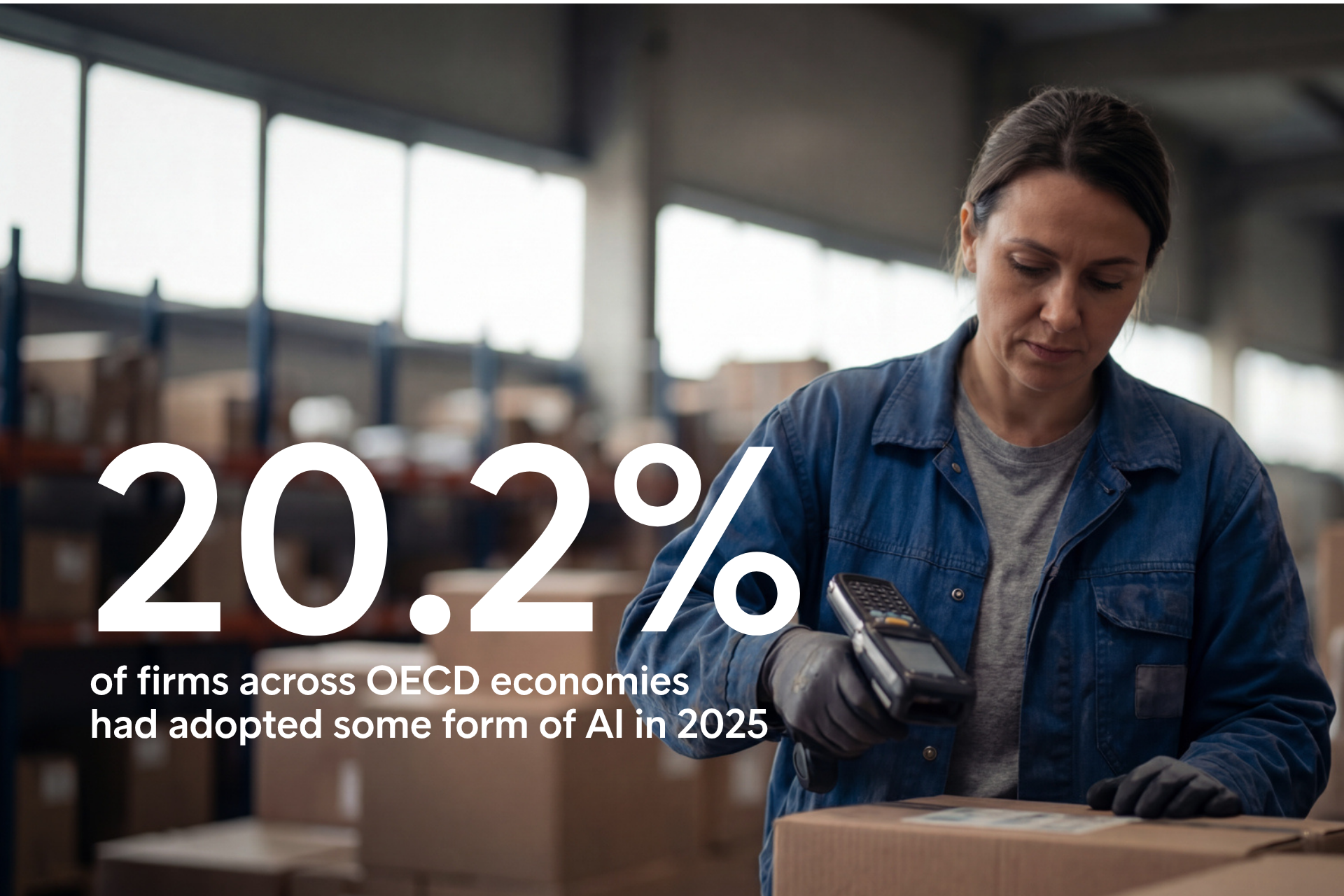
According to the OECD, just over one fifth of firms across its member economies had adopted some form of AI in 2025, up from fewer than one in ten only two years earlier. In Europe, adoption remains slightly below the OECD average but is rising quickly, with Northern European countries leading the region due to strong digital infrastructure and skilled labour markets.
This uneven adoption matters. Large enterprises, which often have stronger digital infrastructure and in-house capabilities, are adopting AI faster than smaller firms. That risks reinforcing existing productivity gaps, especially where smaller businesses lack access to data, skills, technology partners or investment capacity.

Payment management shows where AI can create practical value
AI adoption is particularly advanced in specific operational areas such as payment management. According to Intrum’s European Payment Report 2026, 66% of European businesses already use AI in payment management, up from 57% a year earlier.
This suggests that payment management is one area where AI is already moving from experimentation into practical business use. Businesses are applying AI to improve risk identification, analytics, forecasting, customer communication and payment resolution.

The opportunity is not only to automate individual tasks. The real value comes when AI is embedded into end-to-end processes that improve speed, accuracy, cost efficiency and customer outcomes.
AI can support payment management through:
- Risk identification
- Analytics and forecasting
- Customer communication
- Payment resolution
- Continuous learning and optimisation

Customers are already ahead
While businesses are still scaling their AI deployment, consumers are already becoming more familiar with AI-enabled tools and digital interactions.
In Intrum’s European Consumer Payment Report 2025, 30% of consumers said they would be more likely to be open and honest about their financial situation when talking to an AI tool than to a real person. This compares with only 20% of businesses, surveyed in the European Payment Report 2026, who believe their customers are more honest when engaging with AI chatbots. This suggests that consumer expectations may be moving faster than many businesses realise.

For payment experiences, the direction is clear: customers increasingly expect speed, clarity, personalisation and transparency. AI can help meet these expectations, but trust remains essential.Businesses need to be clear about when AI is being used, how decisions are made and when human support is available.
The AI experience:
- Speed: Faster answers and fewer friction points
- Clarity: Clearer explanations and next-best actions
- Personalisation: More relevant payment options and communication
- Trust: Transparent use of AI and clear access to human support

The real value lies in scaling
Many organisations now use AI in at least one business function, but far fewer have fully implemented it across the organisation. This is where the next phase of AI will be defined.
For businesses, the question is no longer whether AI can be tested in isolated use cases. The question is whether it can be embedded into end-to-end processes where it improves speed, accuracy, cost efficiency and customer outcomes.
In payment management, scaling means moving beyond standalone tools toward integrated systems that support risk assessment, forecasting, customer communication and payment resolution.

Returns will be gradual, but risks are immediate
Structural trends will support further adoption. AI is increasingly embedded in enterprise systems, and declining deployment costs are lowering barriers for smaller firms. The rise of AI agents capable of multi-step tasks is extending automation into more complex processes, while sector-specific platforms tailored to industry needs are improving scalability and practical relevance.
At the same time, challenges remain significant. Uneven adoption may widen productivity gaps, labour market disruption will require reskilling, and high infrastructure costs could increase market concentration. Regulatory frameworks must balance innovation with transparency and accountability.
Overall, AI’s economic potential is substantial but uncertain. The key challenge is moving from adoption to realisation: deploying AI at scale in a way that is efficient, inclusive and aligned with sustainable value creation.
What AI means for Europe’s economy
Download the Economy in Focus #17Previous editions of Economy in Focus:





Insight hub | Most read insight articles
Explore payment trends and economic insightsloading...