
30.09.2026
The financial divide behind flexible payments
The way Europe pays is becoming increasingly flexible. The latest Intrum European Consumer Payment Report (ECPR) shows that buy now, pay later (BNPL) services, which allow consumers to split purchases into smaller instalments or defer payment altogether, are now mainstream.
Highlights of the article
- BNPL has become a mainstream part of how European consumers pay. Germany ranks on top.
- Usage reveals a financial divide: Consumers use payment flexibility for very different reasons, from convenience to managing financial pressure.
- Also in 2026, flexible payment options continue to increasingly influencing where and how consumers choose to spend.
- Responsible use is becoming more important: new EU consumer credit rules will bring stronger affordability checks and protections for vulnerable consumers from November 2026.
According to market research, the European Buy-Now Pay-Later (BNPL) market achieved a compound annual growth rate (CAGR) of 19.1 percent between 2022 and 2025, and is expected to expand from $197.3bn in 2025 to $406.2bn by 2031.
As usage grows, recent ECPR data from Intrum shows that consumers are using BNPL in different ways. Financially resilient consumers in the research use BNPL primarily for convenience, but less resilient consumers use it more to manage cash flow shortages, buy essentials and make purchases they cannot otherwise afford.
This matters, because BNPL is still a form of debt that consumers need to manage carefully. In response, businesses and policymakers must understand who is using BNPL, why they are using it and what it means for the future of payments and financial resilience.
Payment flexibility is embedded in consumer spending
BNPL is no longer a fringe payment method. More than half of consumers (57 percent) say they have used it at some point, and four in 10 have used it in the past 12 months.
Adoption varies significantly across Europe
In Germany, 59 percent of consumers have used BNPL services in the past year, compared with just 20 percent in the Netherlands. Established payment habits may help to explain the differences. Germany has a long-standing culture of paying for goods by invoice after they arrive, while Dutch consumers largely use the iDEAL bank transfer scheme to pay for online orders.
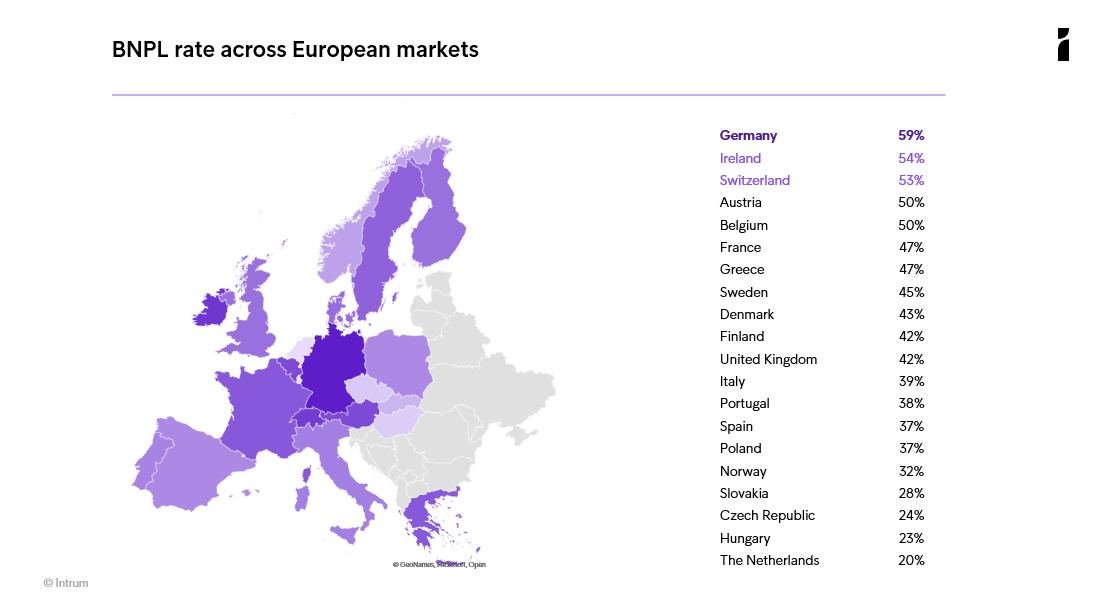
There are also generational differences: generation Z and millennials are more likely than generation X and baby boomers to have used BNPL in the past 12 months. These differences show that businesses that operate in multiple countries and with broad customer bases cannot assume that appetites for payment flexibility are the same across Europe.
Many consumers are using BNPL regularly: more than one-quarter use services at least once every few months. And it is increasingly influencing where consumers make their purchases: 39 percent say they are more likely to make purchases from vendors offering BNPL options, compared with 28 percent in 2025.
The ECPR data shows that payment flexibility is increasingly part of the customer proposition instead of just a financing mechanism. For businesses, offering customers greater choice over when they pay could help them gain an advantage over their competitors.Insights from European Consumer Payment Report 2026, based on data from 20,000 consumers in 20 countries.
If formal BNPL services are not available, consumers still seek out payment flexibility. Nearly half (48 percent) say they are more likely to spend money on services from tradespeople and small businesses if they provide the option to spread payments over time.
These findings suggest that payment flexibility is increasingly part of the customer proposition instead of just a financing mechanism. For businesses, offering customers greater choice over when they pay could help them gain an advantage over their competitors.
But businesses have a responsibility. As BNPL becomes more common, businesses must make sure they can distinguish between flexibility that supports routine financial management and flexibility that indicates or even exacerbates underlying financial distress.
BNPL use reveals a financial divide
Overall BNPL adoption figures conceal a divide: 65 percent of consumers in fragile financial health have used BNPL in the past year, compared with just 17 percent of consumers in resilient financial health. The fragile group is also far more likely to use services regularly: 31 percent use BNPL at least once a month, compared with just 4 percent of the resilient group.
On its own, frequent use does not prove BNPL causes financial difficulty.
Reasons for using flexible payment options
But the reasons behind its use suggest it plays a different role in the lives of people who are already struggling financially. One in five (21 percent) financially fragile consumers say they use BNPL because they would not otherwise be able to afford to make purchases, compared with just 3 percent of financially resilient consumers.
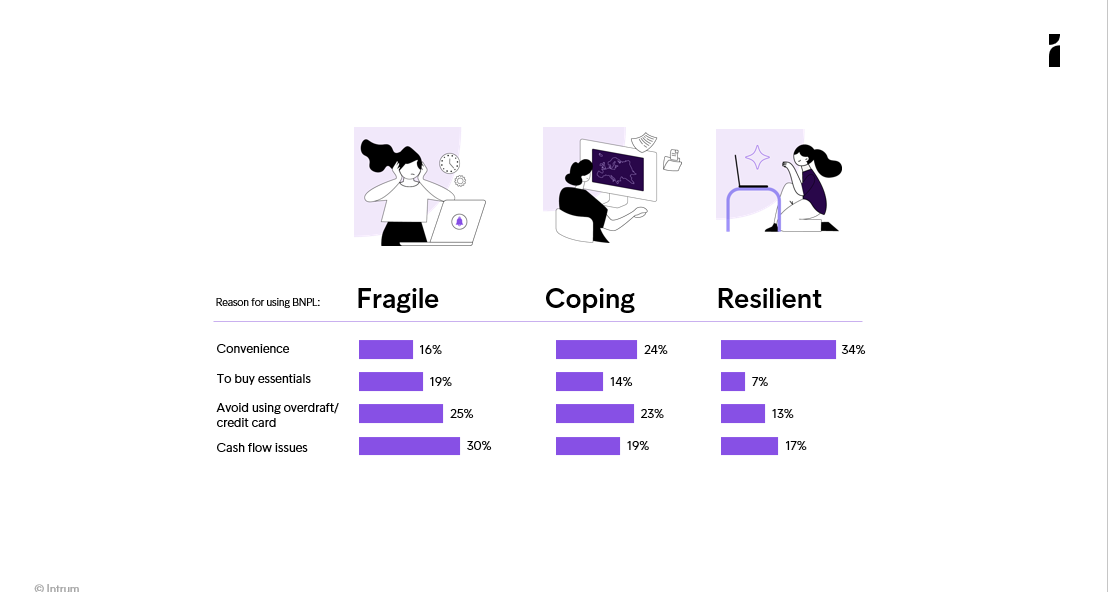
Fragile consumers are also more likely to use BNPL for cash flow management and essential purchases and to avoid using a credit card or overdraft. Resilient consumers say that ease and convenience are their primary reasons.
This does not automatically mean that businesses should withdraw BNPL options. Some consumers will be able to use services without falling into financial difficulties. But it is important to identify dependency before problems escalate.
Frequency of BNPL use, reliance on it for essential spending, missed repayments or other changes in payment behaviour can help businesses to build a more complete picture of financial health and identify potential vulnerabilities quickly – ideally before a customer defaults.
Financially fragile consumers are more likely to use BNPL for cash flow management and essential purchases and to avoid using a credit card or overdraft. Financially resilient consumers say that ease and convenience are their primary reasons.Insights from European Consumer Payment Report 2026, based on data from 20,000 consumers in 20 countries.
BNPL is a regulatory priority
The growing popularity of BNPL and the differences in how resilient and fragile consumers use it may explain why the sector has become a regulatory priority. In October 2023, the European Union revised the Consumer Credit Directive (CCD2) to encompass most BNPL services. From 20 November 2026, BNPL providers operating in Europe will need to adhere to the legislation.
Under the new rules, BNPL providers must perform creditworthiness assessments before providing services to make sure customers are able to make repayments. This protection is particularly relevant in light of the ECPR findings. Greater scrutiny of consumers’ ability to repay could identify early warning signs of financial vulnerability. CCD2 also requires providers to ensure access to advisory services for consumers experiencing financial difficulties.
How effectively these protections will work in practice will become clearer over time. Providers will need to monitor BNPL and respond appropriately when signs of difficulty emerge, while regulators must continually assess whether the rules are protecting vulnerable consumers. The European Commission will undertake an evaluation of CCD2 by 20 November 2029, providing an opportunity to assess progress.
Flexibility should be sustainable
BNPL’s growth reflects increasing demand for control over when and how people pay. But as uptake increases, understanding who is using BNPL – and why – is more important than ever.
Coping mechanism for some
The ECPR findings show that consumers with the weakest financial health use BNPL in ways that could exacerbate their problems, with greater reliance potentially leaving them juggling repayment commitments they cannot afford.
To avoid this, businesses should notice early on when a customer’s payment behaviour changes, and offer tailored support where they need it. Policymakers, meanwhile, must ensure CCD2 delivers its intended protections in practice by monitoring whether financially vulnerable consumers remain disproportionately exposed to problematic BNPL use after the legislation comes into force.
Balancing flexibility with responsible lending
As BNPL becomes a routine part of the payments landscape, its viability will depend on balancing flexibility with responsible lending. It is also important to recognise that a one-size-fits-all approach will not work. Understanding individual circumstances, and responding appropriately when warning signs emerge, will be critical to ensuring that consumers are not given flexibility at the expense of their financial wellbeing.


