
European payment trends 2026: How payment behaviour differs across 20 markets
How long does it take to get paid in Europe, and how does payment behaviour differ between markets?
Drawing on Intrum’s European Payment Report 2026 and European Consumer Payment Report 2026, we examine payment trends across 20 countries, highlighting country differences in payment times and customer behaviour.
Together, the findings offer practical context for businesses trading internationally.
Highlights: What this article covers
- B2B payments: Businesses wait 63 days on average, 20 days beyond agreed terms.
- Market differences: Sweden has the largest B2B payment gap, while Portugal has the longest payment times.
- B2C payments: Stable pattern conceal growing financial pressure: 29% of consumers have paid at least one bill late
- Late payments from customers can have a knock-on effect on a company’s ability to pay its own suppliers on time.
- Public sector payments: The Hungarian public sector stands out with the longest payment time at 76 days and the largest payment gap at nearly 23 days delay after agreed payment terms
How long does it take to get paid in Europe?
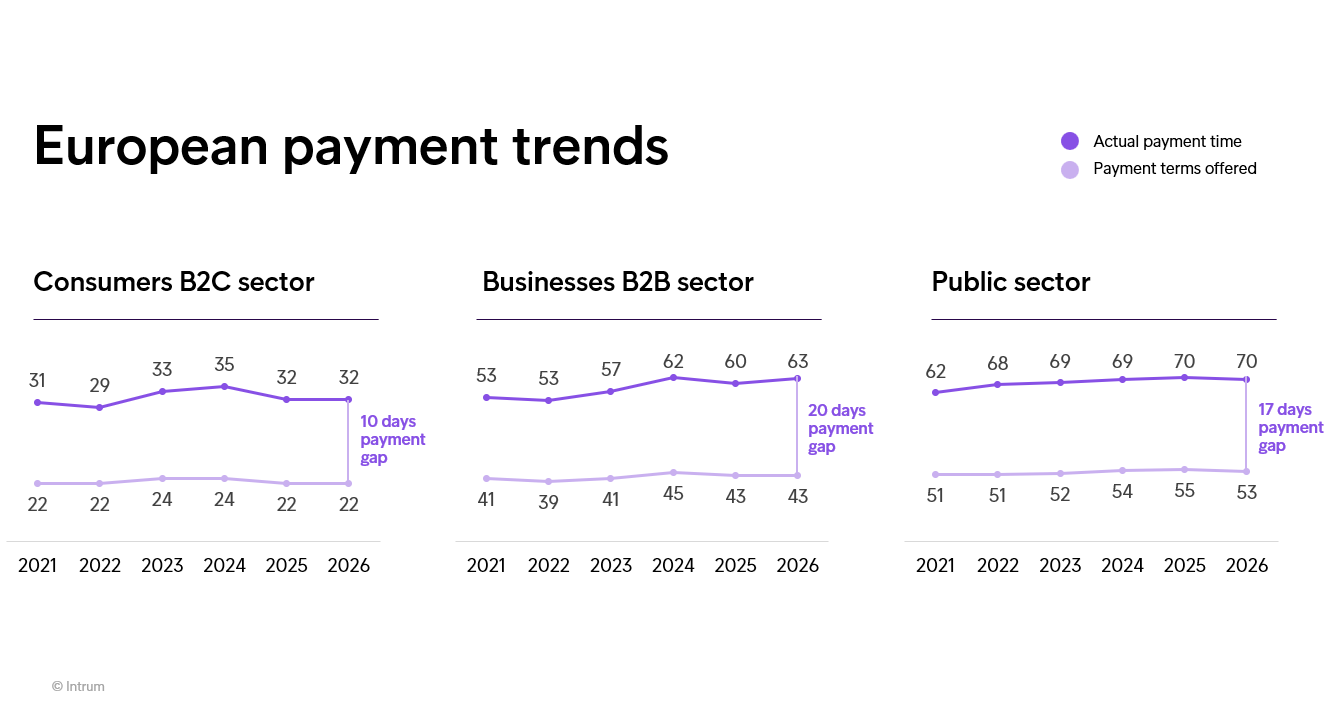
According to Intrum’s European Payment Report 2026, European businesses typically wait 63 days to receive payments from corporate customers, despite offering average payment terms of 43 days. This creates a 20-day gap between agreed terms and actual payment.
Payment patterns differ significantly depending on the type of customer, reflecting differences in commercial practices and payment processes:
Customer segment |
Average payment terms |
Actual payment time |
Payment gap |
| Business customers (B2B) | 43 days | 63 days | 20 days |
| Consumers (B2C) | 22 days | 32 days | 10 days |
| Public sector (B2G) | 53 days | 70 days | 17 days |
What explains the differences in payment terms offered?
-
Consumers: Shorter, more standardised payment processes
Consumer transactions generally involve shorter contractual payment terms and more standardised billing arrangements. Digital payments, e-invoice and automated reminders can also simplify settlement. Consumers typically have less scope to negotiate individual payment terms than corporate customers. -
Businesses: Payment terms are part of commercial relationships
In B2B transactions, trade credit is an established commercial practice. Suppliers may offer longer payment terms to remain competitive, secure contracts or maintain customer relationships. Corporate payment processes can also involve purchase-order matching, invoice verification, multiple approval levels and scheduled payment runs. Cash-flow management and customers' negotiating power can further influence when invoices are settled. -
Public sector: More formal procurement and approval processes
Public-sector transactions may involve additional administrative requirements, including procurement compliance, contract verification and confirmation that goods or services have been delivered.
Europe has increasingly harmonised rules governing payment rights and invoicing, but payment practices, compliance requirements and enforcement still differ substantially between countries and customer segments. EU legislation offers relatively strong protections for commercial creditors, but consumer payment terms are predominantly governed by national law and consumer protection requirements.
However, longer agreed terms do not fully explain the differences in actual payment times.
Intrum's European Payment Report 2026 shows that European businesses continue to struggle to get customers and clients to settle invoices on time, and payment behaviour appears to be deteriorating.
Our research suggests that settlement terms have remained largely unchanged over the past five years, but customers are taking longer to pay.
For businesses trading internationally, agreed payment terms do not necessarily reflect when money will reach the bank account. Both measures matter when forecasting cash flow, assessing credit exposure and planning international operations.
Five payment trends shaping European business in 2026
- B2B payment cycles are becoming longer
- European payment behaviour is far from uniform
- Stable B2C payment pattern conceal growing financial pressure
- Public-sector payment cycles require particular attention
- Payment performance is interconnected across supply chains
Trend 1: B2B payment cycles are becoming longer
One of the clearest developments in European payment behaviour is the widening gap between agreed payment terms and actual payment times in B2B transactions.
In 2021, corporate customers took approximately 53 days to settle invoices. By 2026, that figure had increased to 63 days. Over the same period, average payment terms changed only slightly, from 41 to 43 days. The result is a payment gap that has widened from approximately 12 to 20 days.
This suggests that longer payment cycles are not primarily the result of businesses offering more generous credit terms. Instead, corporate customers are taking longer to settle their invoices.
The trend matters particularly for businesses operating across borders, where payment delays can become more difficult to manage due to differences in language, legal frameworks, customer relationships and collection practices.
Trend 2: European payment behaviour is far from uniform
Although European averages provide a useful benchmark, they conceal meaningful differences between individual markets.
In B2B transactions, Portugal has one of Europe’s longest actual payment times, at approximately 65 days. Sweden, meanwhile, records the largest gap between agreed terms and actual payment, at 21.6 days. Belgium and Poland also stand out, with B2B payment gaps of approximately 21 days.
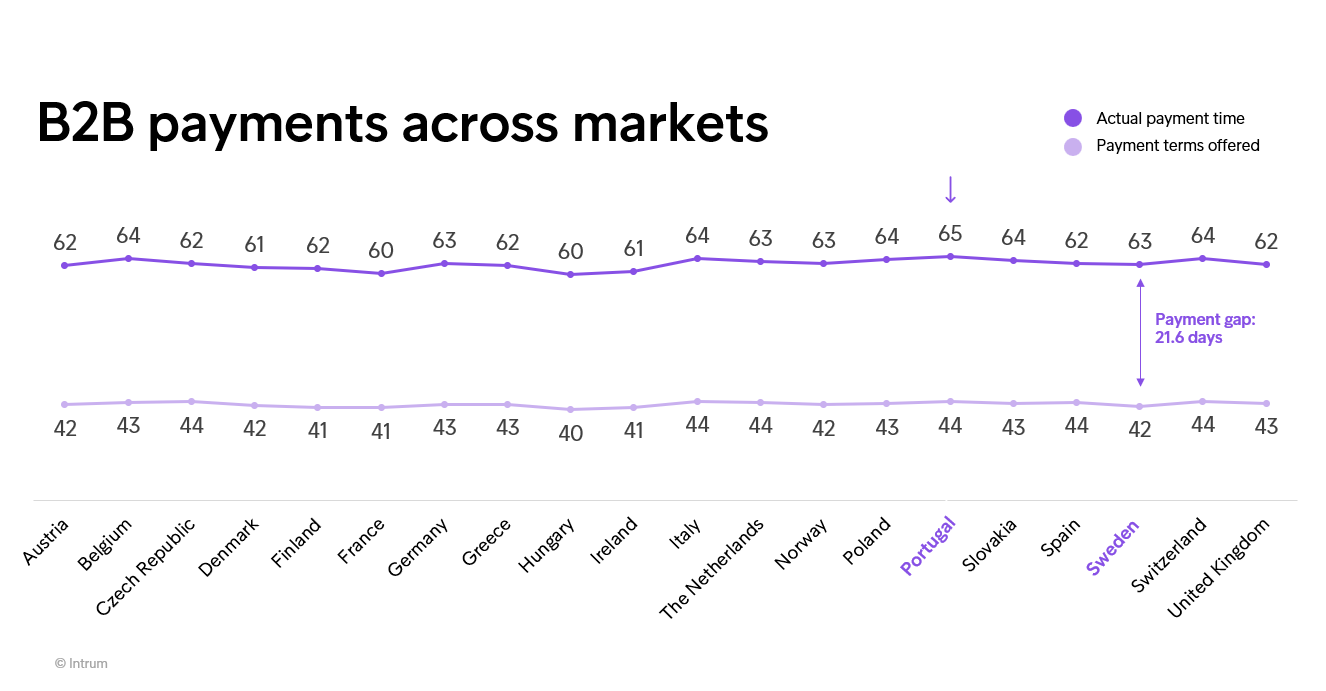
A market where customers take longer to pay is not necessarily the market where customers exceed agreed terms by the greatest margin.
Trend 3: Stable B2C payment pattern conceal growing financial pressure
Consumer payment behaviour shows considerably less variation than corporate or public-sector payments.
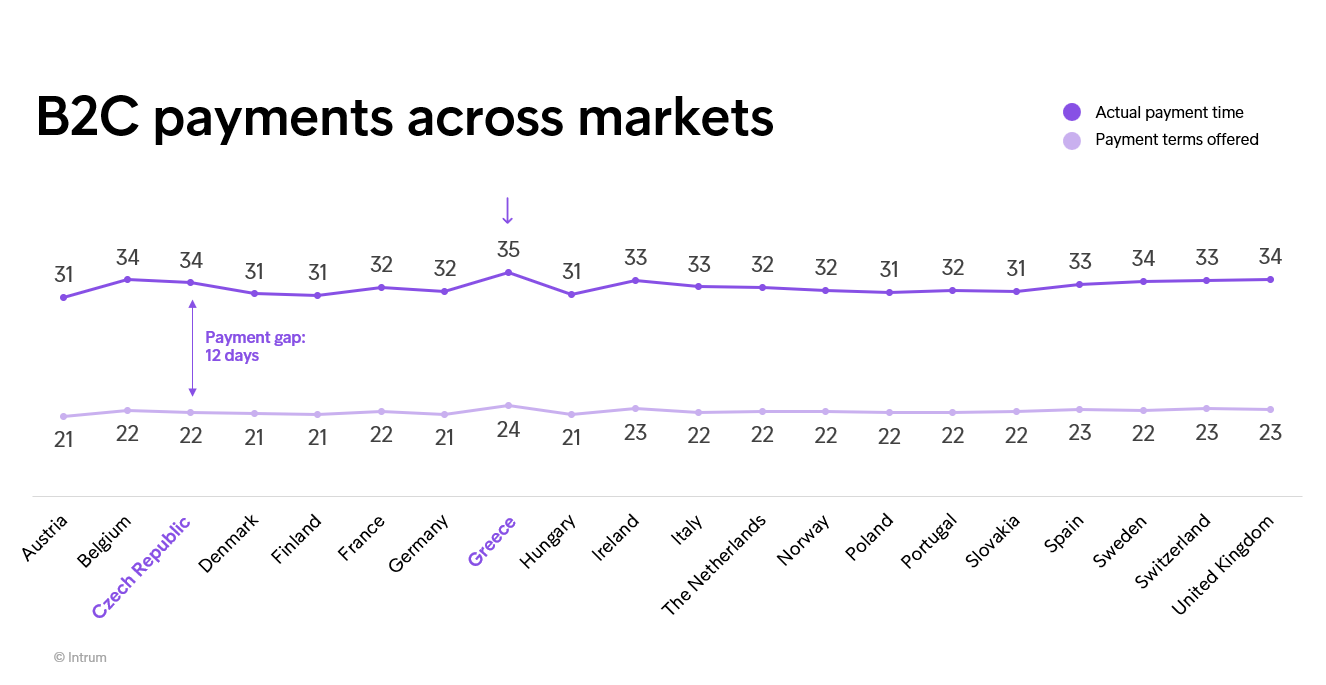
Across the 20 markets surveyed, consumers, on average, pay invoices after approximately 32 days, compared with average payment terms of 22 days. Average payment delay is 10 days after duedate.
The Czech Republic records the largest consumer payment gap, at approximately 12 days, followed by Belgium at 11.6 days. Finland and Slovakia have some of the smallest gaps, at around nine days.
Greece has the longest actual consumer payment time, at approximately 35 days, but also offers longer payment terms than most other markets. Local credit practices and contractual arrangements influence how long businesses should expect to wait for payment.
While average consumer payment times have remained relatively stable, other indicators suggest that payment behaviour across Europe is changing.
The European Consumer Payment Report 2026 reveals a more complex picture:
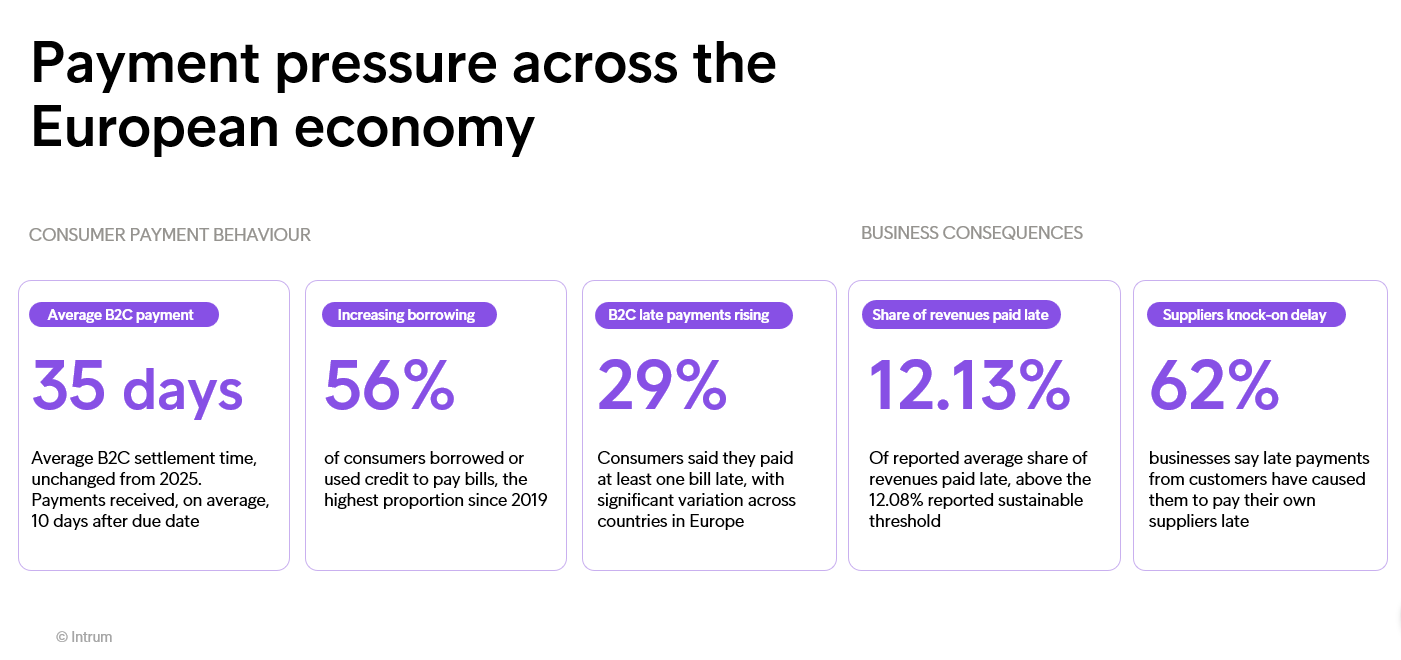
Together, the results suggest that stable average settlement times do not necessarily indicate stronger household finances. Some consumers may be maintaining payment commitments while relying more heavily on credit.
Financial resilience, the incidence of missed payments and local settlement times are complementary indicators of how customer payment behaviour may evolve.
Trend 4: Public-sector payment cycles require particular attention
Public-sector customers have the longest payment cycles of the three segments analysed. Across Europe, public-sector invoices are settled after an average of 70 days, compared with agreed terms of 53 days.
The Hungarian public sector stands out with the longest payment time at 76 days and the largest payment gap at nearly 23 days delay after agreed payment terms.Insights from Intrum's European Payment Report 2026
Hungary records the longest actual payment time, at approximately 76 days, and the largest average payment gap, at nearly 23 days. Portugal and Slovakia also have lengthy public-sector payment cycles, at approximately 74 and 73 days respectively.
At the other end of the spectrum, the Netherlands and Norway record actual public-sector payment times of approximately 67 days, still with close to 20 days payment delay after agreed payment terms.
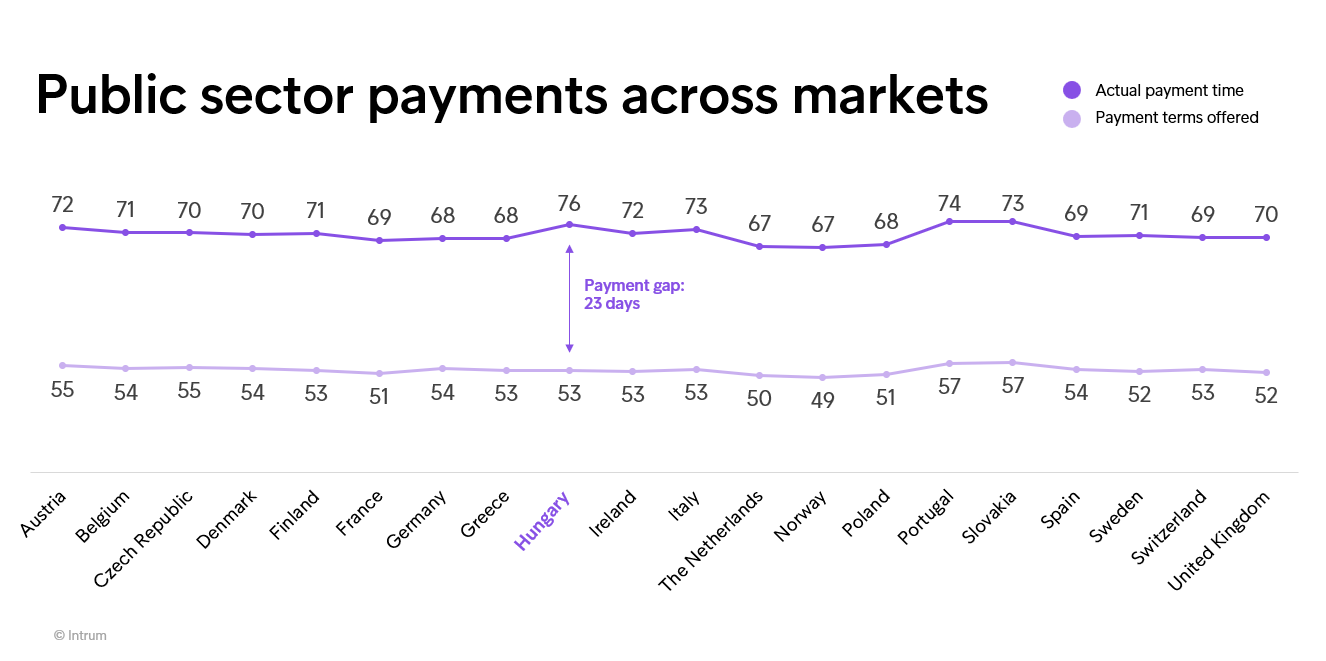
For businesses supplying public authorities internationally, these figures underline the importance of planning for potentially longer settlement cycles.
Public procurement processes, invoicing requirements and statutory payment rules vary between jurisdictions. Observed payment practices and legally permitted payment terms are not necessarily the same
Trend 5: Payment performance is interconnected across supply chains
Payment delays can spread between customers and suppliers, affecting the wider commercial ecosystem. Intrum’s European Payment Report 2026 finds that 62% of businesses say late payments from customers have caused them to pay their own suppliers late.
The consequences? European companies report, on average, that 12.13% of their total revenues are paid late by customers, slightly above what they consider a sustainable treshold (12.08%). Read more about the business consequences of late payments and how they manage the liqiudity crunch.
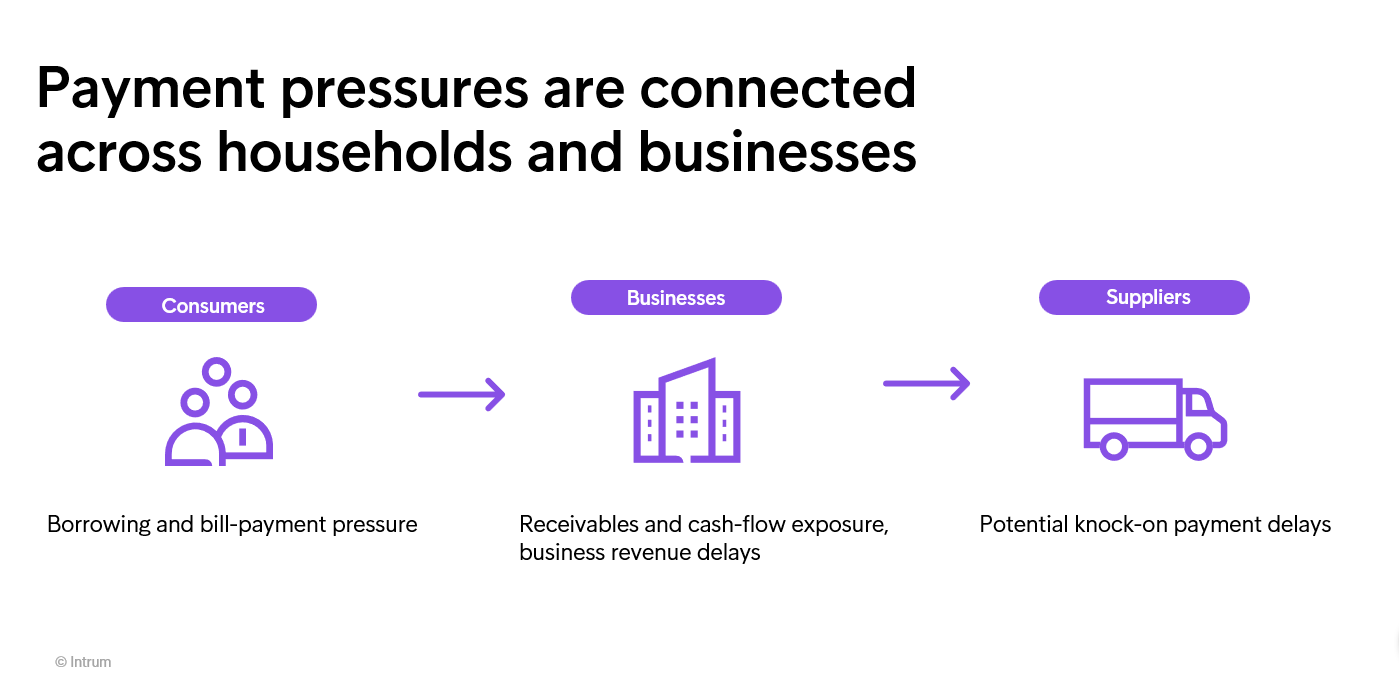
Payment performance is influenced not only by a company’s own financial position, but also by the financial health and payment practices of its customers. A business entering a new market may face indirect exposure to payment pressures elsewhere in its customers’ supply chains.
European payment trends by country: Which markets stand out?
Country-level analysis provides a more detailed picture of payment practices than European averages alone.
There is no single European payment model. Even geographically close markets can display different patterns, while businesses in the same country may experience substantially different payment cycles depending on whether they serve consumers, other businesses or public authorities.
In 2026, some markets stand out:
Market |
Notable payment trend |
Implication for international businesses |
|
| Sweden | Largest B2B payment gap: 21.6 days | Compare contractual terms with expected settlement | |
| Portugal | Longest B2B payment time: approximately 65 days | Allow for lengthy corporate payment cycles | |
| Poland | B2B payment gap: around 21 days | Monitor supplier-payment pressures | |
| Belgium | Elevated B2B and B2C gaps | Assess payment patterns by segment | |
| Czech Republic | Largest B2C gap: around 12 days | Understand local consumer payment practices | |
| Hungary | Longest public-sector payment time: approximately 76 days | Plan for extended public-sector settlement | |
| Germany | 70% report supplier delays caused by customer payments | Consider wider supply-chain exposure |

AI technology is becoming an established part of the European payment landscape
Intrum’s European Payment Report 2026 finds that 73% of businesses are investing in improvements to their payment interfaces, while 66% are using artificial intelligence in some aspect of payment management.
AI-supported technologies can help businesses identify payment risks, automate routine processes, improve communication and manage reminders.
However, adoption varies between markets, sectors and business sizes.
In 2026 we see:
Technology may help standardise payment management across countries, but businesses still need to accommodate local customer expectations and operating environments.
Looking ahead: What will shape European payment trends?
The European payment landscape will remain influenced by economic uncertainty, business confidence, customer financial resilience, regulation and new technologies.
For companies trading across Europe, it is central that understanding payment behaviour requires more than a single European benchmark. The most useful insights come from comparing terms, settlement times and customer segments behaviour at country level – and tracking how those patterns change.